
Article: Why colour matters so much in the Japanese sense of seasons
Why colour matters so much in the Japanese sense of seasons

In Japan, seasons are not simply marked by dates on a calendar.
They are felt — quietly — through shifts in light, air, and colour.
Spring does not suddenly arrive as pink.
Summer is not defined by a single shade of green.
Instead, colours overlap, soften, and fade into one another, creating transitions that are subtle, almost unnoticeable, unless you slow down and pay attention.
This sensitivity to seasonal change has shaped Japanese culture for centuries — from gardens and clothing to everyday objects used without much thought.
Colour, in this context, is not decoration.
It is a way of sensing time.
Seasons as a feeling, not a statement

In many cultures, colour is used to stand out or make a statement.
In Japan, colour often plays a quieter role.
Cherry blossoms are admired not only for their bloom, but for how quickly they fall.
Autumn leaves are beautiful precisely because their colours are never uniform.
There is beauty in what exists between moments —
between blooming and fading, between one season and the next.
Rather than defining seasons with clear boundaries, Japanese aesthetics embrace gradation:
the gentle blending of colours that reflects how time actually moves.
Why gradation feels more natural than a single colour

A single colour feels fixed.
Seasons are not.
In Japan, the transition from spring to summer, or autumn to winter, is rarely abrupt.
There is always overlap — warmth lingering, coolness arriving slowly.
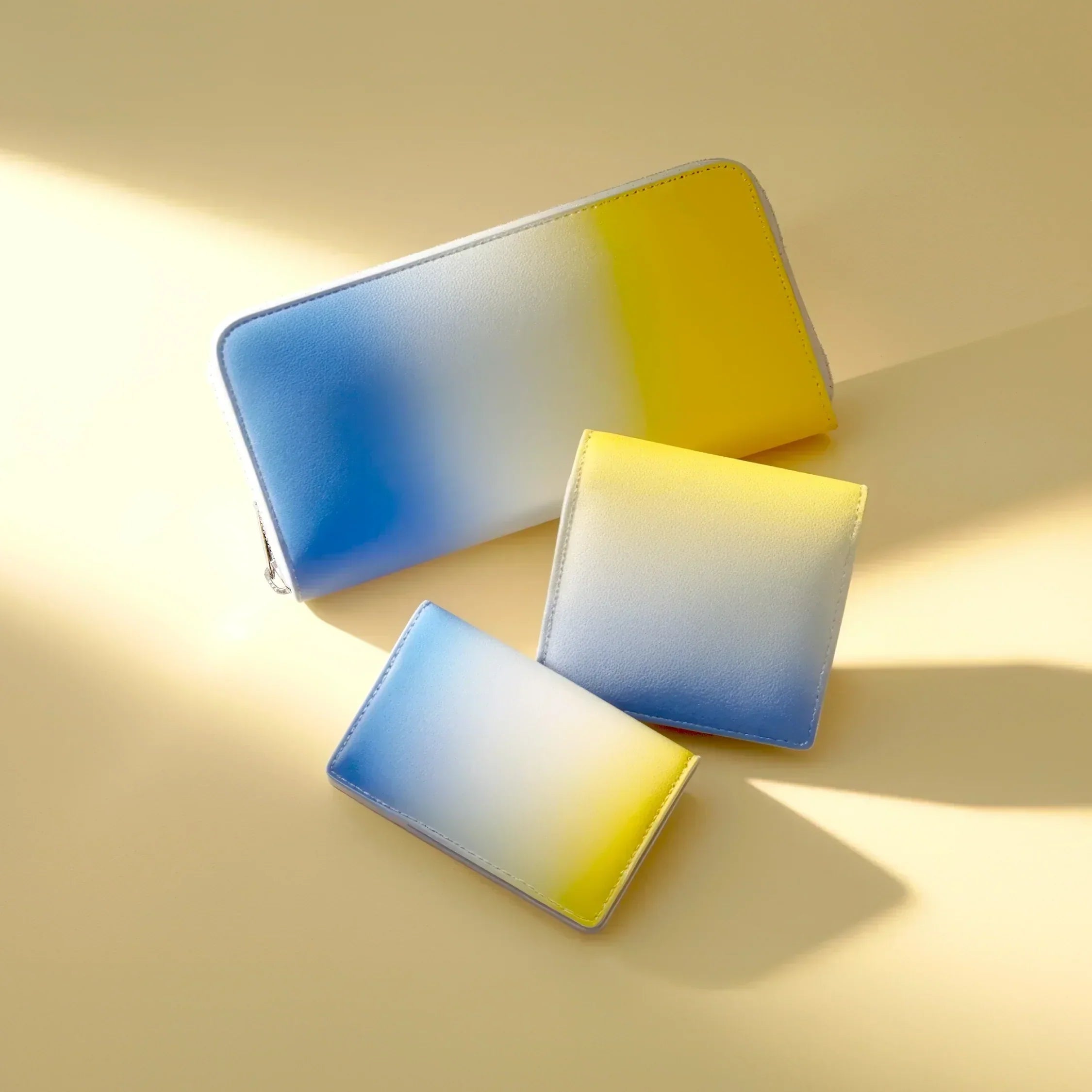
Gradation captures this sense of in-between.
It allows colour to shift gently, mirroring the way seasons are experienced rather than announced.
This idea became central when we began thinking about how colour could be expressed through leather.
Translating sensitivity into leather

Leather does not easily accept gradual colour changes.
Dye naturally spreads unevenly, and controlling how one tone melts into another requires patience, experience, and a deep understanding of the material.
Sharp contrasts are easier.
Soft transitions are not.
But seasons in Japan are never sharp.
By carefully layering dyes by hand, allowing colours to overlap naturally, leather can begin to express something more fluid — something closer to how seasons are felt rather than seen.
No two pieces turn out exactly the same.
Just as no two seasons ever feel identical.
Colour that changes with time

As leather ages, its surface softens.
Colours deepen, blend further, and become quieter.
Rather than losing character, the piece gains continuity — carrying traces of past moments while adapting to the present.
This slow change is not something to resist.
It is something to appreciate.
In Japan, beauty often lies not in perfection, but in how things evolve.
A quiet expression of craftsmanship

This way of working with colour reflects a distinctly Japanese relationship with seasons, time, and restraint.
It is not about trends or bold statements.
It is about harmony, transition, and the beauty found in subtle change.
Through leather, this sensitivity can be carried into everyday life — quietly, naturally, and over time.
If this perspective resonates with you, you can explore the Irodori collection here.

Written by Singapore MOTHERHOUSE


Leave a comment
This site is protected by hCaptcha and the hCaptcha Privacy Policy and Terms of Service apply.